Napoleonic Weaponry
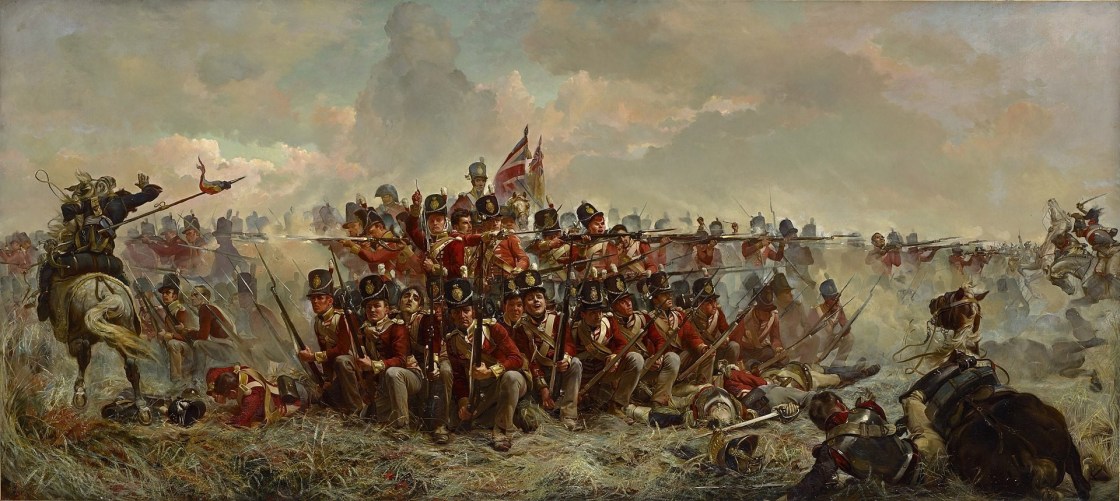 Elizabeth Thompson’s epic painting of The 28th Regiment at Quatre Bras
All successful tactics largely depend on the weapons used. In the Peninsular War, the dominant weapon on both sides was the infantryman’s musket. In the British and Portuguese armies, and increasingly in the Spanish, the infantry of the line were armed with the India pattern musket – a modification of the ‘Brown Bess’, the standard British musket since the end of Marlborough’s wars. This had a smooth-bore barrel, thirty-nine inches long, and a flintlock action. The bore was 0.75 inch and it threw a ball weighing rather more than an ounce (14.5 to the pound). Although the ball would be lethal up to 300 yards, even the most expert shot could not reckon on hitting a target at more than eighty yards. A contemporary writer remarked that ‘a soldier must be very unfortunate indeed who should be wounded by a common musket at 150 yards, provided that his antagonist aims at him’. The rate of misfires was as high as two in thirteen even in fine weather, and in rain it was unlikely that any shots could be fired at all. A trained soldier could reload and fire in between twelve and fifteen seconds. During this time he was defenceless except for his bayonet. The French musket was comparable in performance, but threw a slightly lighter ball, twenty to the pound.
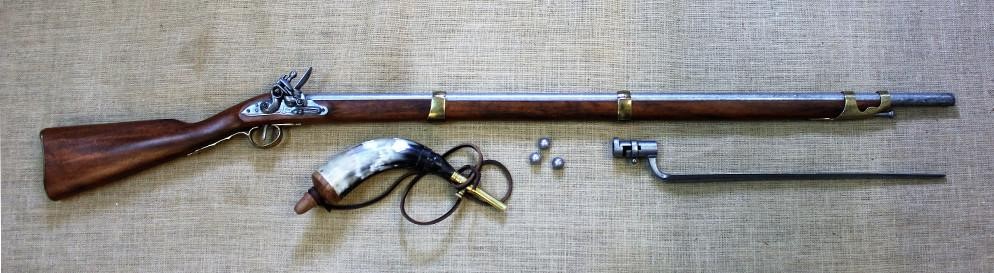 Brown Bess, with powder horn, bayonet and shot (Source: collectorsarmoury.com)
Armed with such weapons, both sides compelled to fight in closer order. Only by forming up shoulder to shoulder and firing in closely controlled volleys either by ranks or by files, could a sufficient weight of balls be thrown at the enemy to keep him from charging home his attack. With so many shots fired, many were bound to find targets. A further cogent reason for a close formation was the vulnerability of dispersed infantry to cavalry. The cumbersome loading of the musket gave the foot-soldier no chance of beating of charging horsemen with fire. It therefore became necessary to form square and present to the cavalry solid lines of bayonets which could not be outflanked. Squares would normally be formed of one or two battalions, and were often oblong rather than square. In case of emergency, it was possible for a small body of men to form a ‘rallying square’, which was a solid knot of men which could be built up by newcomers as they arrived.
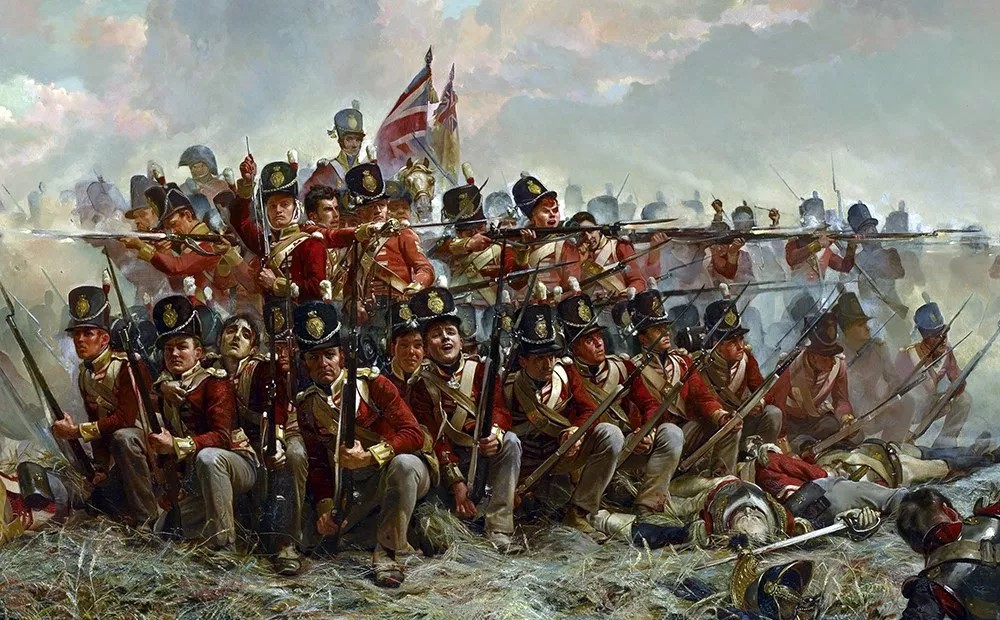 Forming Square (Source: Elizabeth Thompson’s 28th Regiment at Quatre Bras)
In the Allied army, between 3000 and 4000 men were armed with a rifle. This, a flintlock piece with a thirty-inch barrel containing a quarter-turn of rifling, was designed by a London gunsmith, Ezekiel Baker. It was accurate up to 300 yards, but was as liable to misfire as the common musket. It was, in addition, a difficult weapon to load, and even an experienced rifleman could not manage to load and fire in much less that thirty seconds. This was considered to be such a disadvantage that, in 1807, Napoleon ordered the withdrawal of all rifles from his army – a fact that put the French in Spain at a permanent disadvantage in skirmishing. Rifles, on the Allied side, were carried by the 5th battalion of the 60th, by the 95th Rifles, and by a proportion of men in the two light battalions of the King’s German Legion and in the Portuguese Caҫadores.
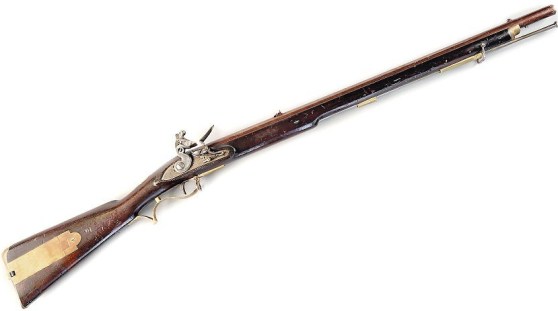
Rifle created by Ezekiel Baker in 1800 (Source: Americanrifleman.org)
The normal field-gun in the Anglo-Portuguese artillery was the six-pounder cannon, that fired either canister or round-shot. Canister, a case containing a large number of small balls, was mainly used at very short ranges, 200 or 300 yards. Round (solid) shot was reckoned to be the most effective at ranges up to about 800 yards, although it could be very dangerous after the shot had pitched. The ‘plunging of shot’, or ‘ricochet’, wrote a surgeon, ‘is a pleasing although awful and deceitful sight, the ball appearing to bound like a cricket ball which inspires poor lads to endeavour to stop it with their foot, which is then smashed to pieces so as to render amputation necessary’.
 Replica of a typical Napoleonic Six-Pounder (Source: Hansen Wheel & Wagon Shop)
Much of the French artillery was of heavier calibre than the Allied but, throughout the war, the British had the advantage of Major Shrapnel’s recent invention of a shell which burst over the heads of the enemy showering him with musket balls. Another British contribution to the science of artillery was the explosive rocket, developed by Sir William Congreve, which gave the Allies some rather erratic assistance in 1813–14.


Portraits of Henry Shrapnel and William Congreve (Source: WikiCommons)
It is important to remember that all these Napoleonic firearms used black powder, which emitted a considerable quantity of smoke. As a result, any close action was fought in atmospheric conditions not differing greatly from one of London’s thicker fogs.
This article is adapted from the Appendix of Michael Glover, Wellington’s Peninsular Victories (London: Pan Books, 1963), pp. 177–9.
 JMG History