The ‘Cinderella’ of Intelligence:
An Historiographical Survey of Photographic Intelligence
This article was originally published in the Autumn 2013 Medmenham Newsletter,
and is reproduced here with kind permission of the Medmenham Club.
In Tim Dunn’s 2011 BBC programme, Operation Crossbow, the Second World War feat of photographic reconnaissance (PR) and the art of photographic interpretation (PI) were placed centrefold in narration of the well-known history of the hunt for the German V-Weapons. The programme was introduced with the words, ‘The Devil’s in the detail now on BBC2 as we share the secrets of an ingenious, if little known, plan’. It is remarkable that so little has been written on this particular source of intelligence. —perhaps because mainstream history prefers the more exciting sources. In the order of their historical popularity, the sources R. V. Jones and his team of scientific intelligencer officers used were Signals Intelligence (SIGINT) and Enigma decrypts, the products of espionage activity, captured documents and hardware, data from the interrogation (surreptitious or otherwise) of prisoners of war, and finally, PR and PI. Each played an equal part in Second World War scientific intelligence investigation, and one was not really any more crucial than the others. So why has photographic interpretation been reduced to being the least-discussed aspect of the wartime intelligence-gathering mechanism of the Allied war machine?
In attempting to answer the question, this article surveys the standard texts on PR and PI, and therefore provides a brief but useful examination of the historiographical treatment of PR and PI at Medmenham as effective wartime intelligence activities. To contextualise these pursuits, this article makes a short comparison of Allied and Axis PR and PI, before rounding off with an assessment of the existing historical legacy of Medmenham. The argument throughout is that so much more needs to be written on this very important yet relatively neglected aspect of wartime British intelligence, and that proposed future historical engagement should not always be made in isolation but filtered in to the wider global narrative of the war.

Anglo-American Socialising at Medmenham
Historians of PR and PI are fortunate to have been provided with two recollections from two ladies who worked at Medmenham during the war; although perhaps unfortunate that there are so few other archived and printed Medmenham memories. Previously employed as a photographer and journalist for the fascinating techno-modernist photo-journal, The Aeroplane, Constance Babington Smith was responsible for the aircraft identification section operating in Danesfield House for much of the war. In 1958 she wrote her Evidence in Camera (London: Chatto & Windus, 1958) which is a superb first-hand account of the importance of Medmenham. Significantly, this publication was introduced by Lord Tedder, who commented that photographic reconnaissance for him was the most fascinating aspect of the Second World War; a story of British genius at its best; a story of imagination, devotion and courage. Just as valuable to historians as primary evidence is Ursula Powys-Lybbe’s The Eye of Intelligence (London: William Kimber, 1983). This lesser-known book provides a significant theoretical approach to PI throughout, encapsulated in the following observation: ‘It is not enough merely to recognise and locate a target – the ‘what’ and ‘where’. Complete exploitation should also answer to a ‘dialectical evaluation’, questioning the reasoning for the presence of an object, comparing it with previous sightings, considering its role, [and] assessing its significance and potential’.
There have been only two significant specific historical studies of Second World War PR. The first, Peter Mead’s The Eye in the Air (London: HMSO, 1983), is essentially an assessment from a British Army perspective (Mead was an Air Observation Post pilot). Although Medmenham does not feature at all, this publication does, nevertheless, provide a good idea of how integral tactical PR was to land operations. Mead commented that the ‘greatest devotion to reconnaissance is found amongst those who have been in direst need of it in battle’. The second significant PR study, Andrew J. Brookes’s Photo Reconnaissance (London: Ian Lane Ltd, 1975), is a meticulous operational history of PR, which also adequately filters in sufficient discussion of PI. Brookes ensured that few stones were unturned during his research, and that the male and female ground-crews and interpreters were not forgotten. For Brookes, British PR and PI ‘earned a professional competence and stature that was second to none [for they] had taken on and surpassed the defensive might of the Luftwaffe and Regia Aeronautica, proved to the Japanese that none of their possessions within range were immune to the attentions of the aerial camera, and demonstrated admirably to the Americans that dedication and perseverance were worth far more than inexhaustible supplies of men and equipment’. PR and PI were phenomenal responses to crises of war and, to a certain extent during the Second World War, photography largely kept pace with the progress of the aeroplane—as aircraft flew higher and faster, cameras and photographic development were required to adapt. It was the British – the Air Ministry, the RAF and the personnel at Medmenham – that inspired this phenomenon.
Two more recent publications on Second World War PR and PI have helped to ease the historical neglect of these subject matters. Robert Ehlers’s and Taylor Downing’s respective publications (both of which were reviewed together in the August 2012 edition of The Medmenham Newsletter) have both made significant beginnings in placing the Central Interpretation Unit (later the Allied Central Interpretation Unit) at Medmenham into its appropriate wartime context. Indeed, in his Targeting the Third Reich (Kansas: University Press, 2009), Ehlers commenced his assessment with a chapter entitled ‘Air Intelligence in its Historical Context’, positing that only a handful of books have discussed such issues in more than cursory fashion. Clearly, as the subtitle to his book suggests, Air Intelligence and the Allied Bombing Campaigns, Ehlers focused on the Allied Strategic Bombing Campaign. In doing so, he strongly emphasised the value of PR and PI to both Bomber Command and the United States Army Air Force (USAAF), and their remarkable collaborative efforts in targeting the Third Reich. In contrast, Taylor Downing’s Spies in the Sky has provided a thrilling narrative of PI/PR during the Second World War, which convincingly portrays Medmenham’s contribution to the various successes of the Allies, particularly in the sinking of German battleships, eventual successes in the Mediterranean, directly before and during D-Day, and in Medmenham’s crucial role in the hunt for the German Vengeance Weapons (V-Weapons). Downing also recounts the creation of the Photographic Reconnaissance Units (PRU) in Britain and across the world, and the Central Interpretation Unit at Medmenham—matters which have been overlooked by far too many Second World War historians.
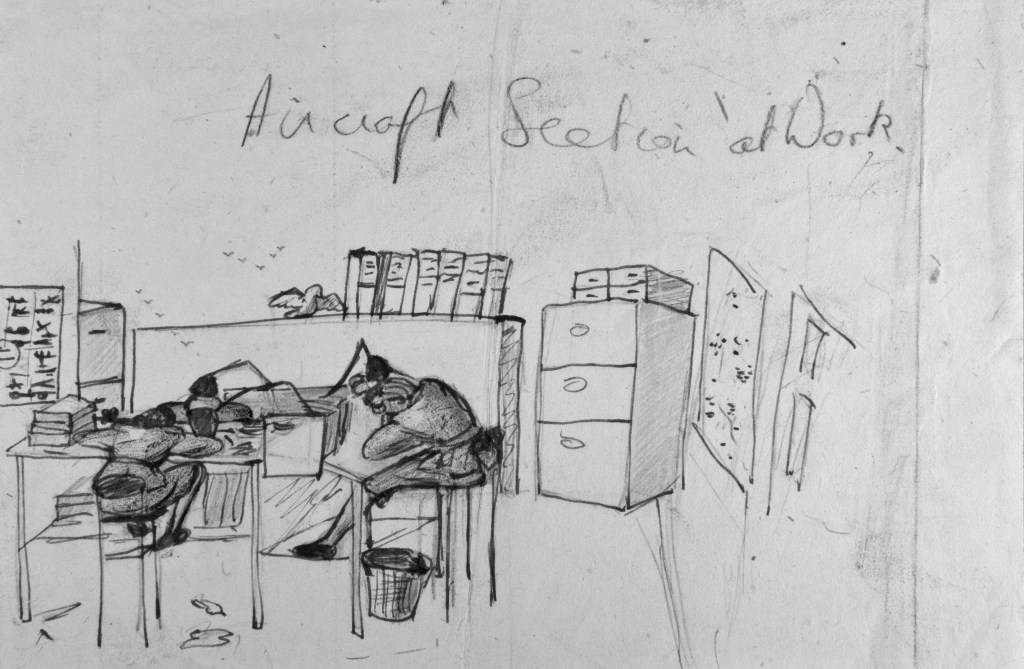
Aircraft Section at Work
Applying documentation from the Medmenham Collection, Downing sketched some of the personalities present at Medmenham. This more social approach to the subject has been impressively advanced by Christine Halsall’s Women of Intelligence (Stroud: Spellmount, 2012). Given that over 800 women worked in photographic intelligence during the war, as this book is uniquely written from the female perspective it provides a more balanced insight into wartime life at Danesfield House and Nuneham Park, and in their adjacent huts, and attached substations and PRUs. The subtitle of this book, ‘Winning the Second World War with Air Photos’, leaves the reader in no doubt over the author’s opinion that the women at Medmenham played a major role in Allied Victory. Given that she has drawn extensively from the memories preserved within the Medmenham Collection, and has beautifully weaved oral recollections into her narrative, it is most unlikely that this book will be surpassed for its value to the history of Medmenham and wartime PR and PI. This being said, however, for all its importance and wonder, Women of Intelligence is yet another publication that will remain isolated from the mainstream history of the Second World War.
There are two Second World War PR and PI specific publications which are predominantly centred upon the importance of aerial photography in the intelligence campaign against Germany’s retaliatory methods of unconventional warfare: Colonel Roy Stanley’s V-Weapons Hunt: Defeating German Secret Weapons (Barnsley: Pen & Sword Military, 2010), and Allan Williams’s Operation Crossbow: The Untold Story of Photographic Intelligence and the Search for Hitler’s V Weapons (London: Preface Publishing, 2013). In his memoirs, R. V. Jones – who at one stage headed the V-Weapons intelligence attack – could not praise PR highly enough as a source, essentially for its naked objectivity. Indeed, photographs were a primary source material and, as such were a key component in his investigations. What he had problems with was the subjectivity of the interpreters and he was particularly scathing about Medmenham’s interpretation in the hunt for the V-Weapons (Medmenham’s ‘greatest victory’ according to Dunn’s BBC programme). Jones chose to recall that he found the rocket despite Medmenham having the same photographs for five days; for him the ‘old firm’ – meaning the Secret Intelligence Service (SIS) – had made the successful interpretation and his success was therefore one in the eye for the Duncan Sandys Crossbow contingency. Within his war memoirs, Most Secret War (London: Hamish Hamilton, 1978), Jones provided a distinctly vainglorious impression of his role combined with admonishment for much of Medmenham’s contributions. Most interestingly, Powys-Lybbe wrote her book (she commented) because of Jones’s ‘marked lack of objectivity’ in the 1977 TV airing of The Secret War, and wished to rectify the matter, thereby giving Medmenham its proper status as a branch of intelligence. She recalled that Jones helped Wavell with information to clear up the mysteries surrounding German defence radar system, rather than the other way around. Powys-Lybbe’s and Stanley’s contributions to the history of British intelligence during the Second World War are rare for their professed determination to disagree with Jones’s accounts of events, yet are exclusive to PR/PI. Moreover, it is refreshing that Christine Halsall’s book makes no mention of Jones whatsoever—a milestone perhaps on the road to correcting the history of scientific intelligence and its integral pursuits of PR and PI.

R. V. Jones at the University of Aberdeen
Nevertheless, it is remarkable that, other than the publications discussed above, wartime PR and PI have been so marginalised within the historical narrative. Second World War history has been inundated with books about agents, double agents, deception, resisters, and the Special Operations Executive (SOE). Since the eventual acknowledgement of Bletchley Park and the Ultra Secret, there has been a plethora of publications on the value of SIGINT and the Enigma decrypts; so much so in fact that photographic aerial imagery as an intelligence source has since resided in Ultra’s shadow. Some examples of Second World War histories show this undeniably. In Martin Gilbert’s tome entitled Second World War (London: Weidenfeld & Nicolson, 1989), ULTRA is discussed thirty-three times, on top of thirty-four mentions of Bletchley Park, and 124 of Enigma. PR on the other hand is afforded two mentions (relative to the photographing of German oil supplies, and the V-Weapons unsurprisingly), while the art of PI itself and its value to Allied victory is not discussed at all. Gerhard Weinberg’s expansive survey of A World at Arms (Cambridge: CUP, 1994) is another typical example, in which again there is no mention at all of Medmenham or PI, yet code-breaking merits twenty-four mentions. Similarly, John Keegan’s history of the Second World War (London: Pimlico, 1997) mentioned Ultra four times, Bletchley three, but no mention of Medmenham or PI.
More recent publications have followed the same trend. Spencer Tucker’s examination of the Second World War (London: Palgrave, 2004) mentions SIGINT nine times (three times each for Ultra, Bletchley, and Enigma), but does not mention Medmenham or PI. Max Hastings’s examination of Winston Churchill’s Finest Years (London: HarperPress, 2009) lavishly places Ultra as the centrepiece of British intelligence with nineteen mentions, with seven additional mentions of Bletchley Park, and one of Enigma, but provides no discussion of Medmenham or PI. Gordon Corrigan’s recent military history perspective of The Second World War (London: Atlantic Books, 2010) also failed to discuss aerial photography or its interpretation, yet there is significant discussion on the clandestine activities of SOE, and its U.S. equivalent, the Office of Strategic Services (OSS). Even Evan Mawdsley’s ‘new history’ of World War II (Cambridge: CUP, 2009) places Ultra centre stage in Allied intelligence, but makes no mention of the importance of Medmenham and PI.

The Art of Photographic Interpretation
Perhaps the precedent was established by Winston Churchill, who truly appreciated the value of PR and PI, not least because his daughter Sarah worked at Medmenham. Yet in his memoirs, he chose to mention Medmenham by name only once, and that was in a post-war letter which questioned the use of Medmenham to undertake a total aerial survey of Europe. The PRUs were mentioned by Churchill relative to the 1942 radar-grab at Bruneval; in a May 1942 letter from Churchill to the Chiefs of Air Staff requesting a sortie be sent over Tirpitz; the provision of PRU Spitfires for operations from North Russia was discussed in a letter to Stalin in September 1942; as was the photographing of bomb damage following raids on Berlin between November 1943 and March 1944. But that was the extent of Churchill’s discussion on such a crucial aspect of Allied intelligence.
There have, however, been snippets of useful (albeit specific) data in books such as George Millar’s The Bruneval Raid (London: The Bodley Head, 1974) and Taylor Downing’s latest contribution Night Raid (London: Little, Brown, 2013). The PR and PI remit for both of these books is clearly Medmenham’s role in this particular raid to snatch German Würzburg apparatus. Millar provided other gems, such as the tendency with high-grade interpreters was specialisation, and this was sensibly encouraged. Michael Spender, for example, continued to specialise in German ships and harbours, Babington Smith in German aircraft and Claude Wavell specialised in German radio and radar installations. The imperative work of the latter two pursuits became integral to scientific intelligence—a fact only alluded to in Jones’s war memoirs. Millar also noted that ‘dicing’ was a good bit of RAF slang, and the activity became so important that Squadron Leader Geoffrey Tuttle (C/O of Benson PRU) had the PR Spitfires painted pale pink, since that colour had been proved on trials to be better (low down) than the original duck-egg green. Other specific examinations of Second World War incidents, such as Alfred Price’s Instruments of Darkness (London: William Kimber, 1967) portray the work of Medmenham as rather non-descript and matter of course.
Most studies of intelligence have at least placed Medmenham into the wartime intelligence context but, even then, such writings are further isolated from the popular Second World War narrative. Amongst the more generic intelligence histories, the most concise and yet meticulous is Christopher Andrew’s Secret Service: The Making of the British Intelligence Community (London: Heinemann, 1985). Andrew offered some real delights and insights into the forerunner of Medmenham and early PR and PI under Sidney Cotton. For example, the Photographic Development Unit (PDU) had a badge bearing the cryptic symbols ‘CC11’: CC stood for ‘Cotton’s Crooks’; 11 referred to the eleventh commandment — ‘Thou shalt not be found out’. On Cotton’s dismissal, Andrew wrote that Cotton denounced it as ‘cowardly in the extreme’, and put it down to bureaucratic jealousy and inter-departmental rivalry. But there was more to it than that. Cotton dressed up in funny hats in the French mess’ and ‘really played the fool’ in the company of women. Other complaints were more serious. Cotton was alleged to have been concerned in running a Paris brothel and tried to use a Lockheed to fly a French textile magnate from Bordeaux to Britain after the collapse of France, instead of looking after essential equipment and personnel. The Air Ministry therefore wanted a less controversial commander for their first PRU, which of course, as Andrew rightly commented, was understandable. All this is highly interesting, yet remains subliminal to the evaluation Andrew made by stating that the PRU was a major innovation of SIS, alongside that of the ‘dirty tricks department’—Section D of SIS which evolved into SOE. Another key text is Ralph Bennett’s Behind the Battle: Intelligence in the War with Germany (London: Sinclair-Stevenson, 1994) which, more than any other history, emphasises the Anglo-American nature of Medmenham, declaring it as the first fully integrated Allied HQ that paralleled or narrowly anticipated the development of army-air Ultra at Bletchley. The four-volume magisterial official history of British Intelligence in the Second World War (London: HMSO, 1979-88) placed aerial photography into its rightful context, but this publication’s rarity and characteristically dry and rather impersonal manner makes this particular history inaccessible to most. The official historians, led by Harry Hinsley (a wartime Bletchley operative), also relied far too heavily on the documents left behind by Medmenham’s bureaucratic clients, and memoirs (like Jones’s Most Secret War) which further marginalised PI, and not nearly enough on the memories of the PR/PI personnel themselves.
Some histories have excluded Medmenham from its rightful place altogether. A prime example is Martin Middlebrook’s narrative of The Peenemünde Raid (London: Allen Lane, 1982), in which he noted the ‘first phase’ interpretation of the Scottish PRU at Leuchars, but entirely omitted the crucial V-Weapons discoveries by Medmenham’s second and third phase PIs which ultimately led to the 17/18 August 1943 raid. Many books have been written about D-Day without any reference to the 8.5 million aerial photographs taken and analysed in preparation for the Allied invasion of occupied France. Medmenham was an Air Intelligence organisation, which itself was a branch of the Air Ministry. Aerial photographs were essential to almost all of the Allied air offensives and defences, such as the Allied bombing campaigns and the attack on the V-Weapons. But aerial photography was also crucial to the other two services. For example, it enabled the Royal Navy to watch the assembly of an invasion fleet for the first time in history, and assisted the Army in preparation for the Allied invasion of Europe. Roy Stanley’s latest publication The Normandy Invasion, June 1944: Looking Down on War (Barnsley: Pen & Sword, 2013) is a most welcome contribution to this specific aspect of PR and PI. Over 700 German radio stations were located by PRU in 1942 alone and, two years later, paved the way for Operation Overlord with the compilation of the Rhubarb operational reports that detailed most of the significant targets to be attacked in advance. Once a beachhead had been established in Normandy, high-level photographic reconnaissance of river-lines, airfields, coastal areas and railway marshalling yards tended to anticipate future operations—whilst at Medmenham at the same time the PIs hunted down the V-Weapon sites with the utmost tenacity. The Medmenham product, therefore, was indeed as much a vital element to Allied victory as were the products of Bletchley Park. The latter may well have been the discoverer of potential threats, but PI was the confirmer; Ultra may well have informed the British that there were indeed needles to find, but PR and PI helped Allied intelligence to find them within a very big haystack.
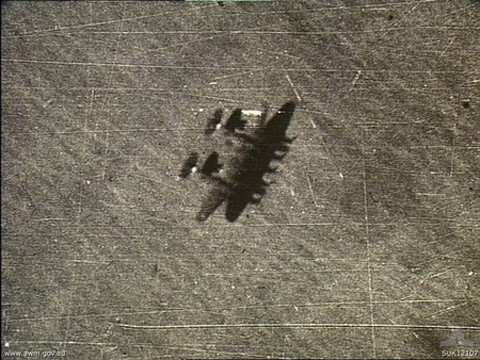
He 111Z at Regensburg 1944
Examinations of wartime PR and PI permit fabulous insight into aspects of the war that other narratives all too often overlook. Some examples are the German use of decoys; construction of midget submarines; the powerful Todt construction of immense U-Boat pens spanning from Trondheim to Bordeaux; that Japanese cruiser submarines made use of the U-Boat base in Lorient which was watched daily by PRU; and the concoction of two He111s forming a tug for the German ‘Gigant’ troop-carrier. Confirmation that the Allies had little notion of the German nuclear programme also becomes evident, for Medmenham’s Industry Section were employed in a vigilant watch on any such activity from the summer of 1944. The Model Section of Medmenham further emphasises the combined efforts. V-Section not only provided models for the Combined Operations raids at Bruneval, St Nazaire, Dieppe, and the Vermork Heavy Water Plant in Norway, but also for the Dambusters Raid, the various attacks of the Tirpitz, the V-Weapons sites, the underground production sites, and many industrial targets. In all some 1000 exact and detailed models were constructed and distributed across the services. Medmenham also produced, in conjunction with MI10, flak maps to assist the bomber crews. Furthermore, it can easily be argued that the German aircraft industry moved underground as a consequence of Medmenham’s meticulous cover of German aircraft manufacturing and subsequent Allied bombing of German factories and production lines.
It is instructive to compare Axis PR and PI with that employed by the Allies. In his excellent comparative history of The Air War, 1939-1945 (London: Europa Publications Ltd, 1980), Richard Overy stated that the deteriorating returns from PR were yet another problem confronting the Axis powers. While the Japanese air force failed to develop reconnaissance aircraft with sufficient speed or height to effectively learn of American intentions, the German Air Force persisted in the acquisition of tactical PI. The Luftwaffe continued to arm their reconnaissance aircraft, and also struggled technically in fitting cameras into their fast, small aircraft. Moreover, PI for the Axis powers remained decentralised, while any strategic intelligence that did exist declined rapidly as the war progressed, particularly in the west. Contemporary confirmation of this was provided by Babington Smith who wrote of the immediate post-war discovery of the German Print Library found in a barn near Bad Reichenhall, which consisted of row upon row of big green boxes full of photographs; most of them of the Eastern Front. Following interrogation of the elderly gentleman in charge of the German interpretation school, the Allies further discovered that the German PIs were trained to work on single prints, rather than using stereoscopes; also that they were all non-commissioned, except for one officer in command of each unit. Von Fritsch’s dictum therefore, that the side with the best photographic reconnaissance would win the war, certainly appeared to have been accurate in every respect.
This statement requires deeper examination through further comparison before resting upon the assumption. As Overy continued, compared to the Axis scenario, Allied experience was almost exactly the reverse. British forces were poorly prepared initially in PI, but what began as an unorthodox quick-fix application to alleviate this neglected aspect of intelligence gathering, later became a strategic powerhouse; and because it was Allied (predominantly Anglo-American) it ended the war as the best photo-interpretation organisation in the world. The Allied armed forces, as Overy concluded, came to expect a high level of PI for almost all operational preparation throughout the duration of the war. Chairing a seminar of the RAF Historical Society in 1991, R. V. Jones also raised the significance of this contrast and considered which of the two sides he would have backed in 1939: the Germans took a strong lead, for they had better scientific instruments, better cameras with marvellous Zeiss lenses, and a most promising photographic aircraft in the Heinkel 119, as well as the ability to produce high-quality photographs on a relatively large scale. ‘How was it’, Jones asked, ‘the war should have seen this complete reversal of the state of competence?’
This is a difficult question to answer precisely, for there were many different reasons that can only be understood through close scrutiny of the evidence that exists pertaining to all aspects of Britain’s war machine. From a total of 206 in 1940, the number of Medmenham personnel rose to a peak of 1,175 in 1945. Few left traces of their exemplary wartime work. Unlike Ultra, British methods of PR were hardly secret, for they were publicly displayed in the April 1941 edition of The Photographic Journal and reprinted in The Illustrated London News in March 1944. These highly effective methods of Allied intelligence gathering could so easily have been copied by the Germans; or at the very least eradicated. PI on the other hand was secret, although not secret enough to ‘keep mum’ after the war. Most did however, and so the historical source base for PR and PI is very thin indeed. This does not excuse historians from excluding photographic intelligence from the mainstream narrative of the Second World War.
Kevin Jones in his article ‘From the Horses Mouth: Luftwaffe POWs as sources for Air Ministry intelligence during the Battle of Britain’, Intelligence and National Security, 15: 4 (2000), 60–80) wrote that prisoner of war (POW) intelligence has been undervalued and unjustly neglected by historians – that it was the ‘Cinderella subject’, confined to the kitchen by the ‘ugly sisters of Sigint and Ultra’. However, POW interrogation transcripts are also very thin on the ground, and when discovered are particularly difficult to contextualise within historical narratives, essentially because the subject matters under examination were often so specific. Historians do not have the same excuse when it comes to photographic intelligence. There are ten million surviving photographs, many in 3-D, safely stored in Edinburgh. Perhaps a photograph cannot physically tell us a great deal today, yet during the war, these same photographs spoke volumes to the wartime interpreters at Medmenham. It is the products of the PRUs and of Medmenham that continue to be the ‘Cinderella’ of Second World War intelligence—the humble domestic slave of the two older, more popular and extrovert sisters, espionage and SIGINT.
What started out in the Great War as the primary servant of the Army, became in the Second World War the courted princess of the three military services. This is evident in the questions posed; ‘what is the minimum turning circle expected of the Tirpitz when under attack?’; ‘what is the volume of water contained in the Möhne reservoir over a specified period?’; ‘what is the height of that bridge?’; ‘what are the defences, and height of the adjacent trees, buildings, and river banks?’; ‘what is the thickness of concrete on the roofs of the submarine shelters at Brest?’. As Powys-Lybbe enthused, ‘people always went away satisfied’. Dunn’s ‘Operation Crossbow’ programme noted that the interpreters of Medmenham ‘may not have achieved the celebrity and recognition of their intelligence colleagues at Bletchley Park, the reconnaissance pilots lacked the glamour of the fighter boys at the Battle of Britain. But their unsung contribution to the war was as important as either’. The voices of those who flew the Blenheims and the Spitfires, the Marylands and the Mosquitos, from Heston and Benson, and from Wick to St. Eval, and all the other PRU bases in Britain, not forgetting those at Malta and the Middle East, but especially the voices of the interpreters from Medmenham, deserve to be much more than just an unsung contribution. It is up to historians to ensure that their voices are heard, so that their valuable efforts and sacrifices are never forgotten, and are permanently situated within the mainstream historical narrative of Second World War.
 JMG History